Bruce Ackerman Honored for His Intellectual Leadership in Advancing Contemporary Democratic Constitutionalism and the Rule of Law
TAIPEI, June 18, 2026 /PRNewswire/ -- The 2026 Tang Prize in Rule of Law has been awarded to Professor Bruce Ackerman, Sterling Professor of Law and Political Science at Yale University, in recognition of "his intellectual leadership in developing new conceptions of constitution-making, judicial review, and the structures needed for democratic constitutional governance, offering conceptual and practical approaches to defend the rule of law amid the crises facing modern republics. His comparative engagements and passionate commitment to understanding constitutional legitimacy and popular sovereignty, exercised across generations, have inspired constitutional lawyers around the world in their pursuit of social justice and the rule of law."
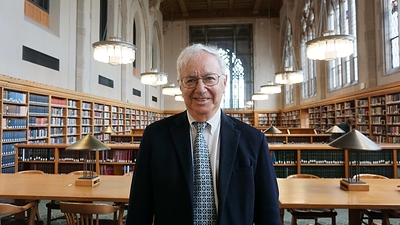
Professor Ackerman's contributions to the rule of law center on his groundbreaking theory of "dualist democracy," which distinguishes between "ordinary politics" and "constitutional politics." Under "constitutional politics," when citizen mobilization reaches its peak, forming a decisive consensus that is later institutionalized into the constitutional order through constitutional mechanisms, it gives rise to a "constitutional moment." This theory provides an essential analytical perspective for the current challenges facing both the constitutional order of the United States (U.S.) and contemporary democracies.
Professor Ackerman's intellectual reach is also deeply grounded in the realm of social justice. He views all citizens as "stakeholders" in society, arguing that the state must address the material inequalities that prevent citizens from becoming full political actors, and ensuring that all citizens possess sufficient economic resources to take part in the public reason process, thereby enabling effective democratic participation.
Professor Ackerman's efforts to bridge theoretical breakthroughs with real-world institutional solutions have been so substantial that their impacts are extensive. His book The Stakeholder Society (with Anne Alstott) has inspired relevant policy initiatives in countries such as the United Kingdom and Brazil; Deliberation Day (with James S. Fishkin) has inspired deliberation initiatives and mechanisms in the U.S. and other countries such as Mongolia; another of his works, Before the Next Attack, likewise inspired the relevant reform of emergency powers in the French constitution.
As a thinker, legal scholar, and educator, Professor Ackerman's thoughts continue to inspire generations of constitutional lawyers around the globe, guiding all toward a more inclusive, resilient vision of rule of law in an era interwoven with crises.
About the Tang Prize
Since the advent of globalization, humanity has enjoyed unprecedented benefits from advances in civilization and science. Yet a multitude of challenges, such as climate change, the emergence of new infectious diseases, the widening wealth gap, and moral degradation, have surfaced along the way. Against this backdrop, Dr. Samuel Yin established the Tang Prize in December 2012. It consists of four award categories: Sustainable Development, Biopharmaceutical Science, Sinology, and Rule of Law. Every two years, four independent and professional selection committees, comprising many internationally renowned experts, scholars, and Nobel laureates, choose Tang Prize laureates who have made substantive contributions and generated a far-reaching impact on the world, regardless of race, nationality, gender, or religion. A cash prize of NT$50 million (approximately US$1.6 million) is allocated to each category, with NT$10 million (approximately US$320,000) of it being a grant intended for research or educational outreach programs to encourage professionals in every field to examine mankind's most urgent needs in the 21st century, and become leading forces in the sustainable development of human society through their outstanding research outcomes and active civic engagement.
 View original content to download multimedia:https://www.prnewswire.co.uk/news-releases/2026-tang-prize-in-rule-of-law-announced-302804241.html

Auf einer der wichtigsten Bahnachsen Ostbayerns ruht für ein halbes Jahr der reguläre Zugverkehr. Die DB InfraGO hat die Korridorsanierung der Strecke Obertraubling–Passau gestartet und die Verbindung weitgehend voll gesperrt. Von diesem Sonntag an bis zum Fahrplanwechsel am 12. Dezember wird die Infrastruktur auf rund 120 Kilometern umfassend erneuert. Das Investitionsvolumen liegt nach Bahnangaben bei rund 1,3 Milliarden Euro inklusive Risikopuffer.
Die Arbeiten schließen unmittelbar an die seit Anfang Februar laufende Generalsanierung der stark befahrenen Strecke Nürnberg–Regensburg an, die bis 10. Juli abgeschlossen sein soll. Auf dem Abschnitt bis Passau erneuert die Bahn Gleise, mehr als 140 Weichen und etwa 90 Kilometer Oberleitungen. Mehrere Stellwerke werden ersetzt oder instand gesetzt, veraltete Relais‑Technik weicht moderner Elektronik. Hinzu kommen eine Eisenbahnüberführung und fünf Personenunterführungen; im Bereich Osterhofen muss an einer Moorstelle nahe der Donau der Untergrund aufwendig verfestigt werden. Acht Bahnhöfe werden modernisiert und mit höheren Bahnsteigen schrittweise barrierefrei ausgebaut – Arbeiten, die bis ins Frühjahr 2027 hineinreichen.
Für Reisende hat die Sanierung gravierende Folgen. Im Nahverkehr richtet die Bahn zusammen mit der Bayerischen Eisenbahngesellschaft ein dichtes Netz an Schienenersatzverkehr ein. Rund 90 Busse sind auf sechs Linien unterwegs; sie und die Wegweiser sind in auffälligem Purpur gestaltet, um die Orientierung zu erleichtern. Im Fernverkehr entfallen die Züge zwischen Nürnberg beziehungsweise Regensburg und Passau sowie weiter nach Wien komplett. Fahrgäste Richtung Österreich werden auf Verbindungen über München verwiesen, zusätzliche Züge über Mühldorf und Salzburg sowie ein Ersatzbusangebot für Passauer Fernreisende sollen die Auswirkungen abfedern.
Aus der Politik kommt grundsätzliche Unterstützung, zugleich aber auch der Hinweis auf die Belastungen für Region und Wirtschaft. Der Parlamentarische Staatssekretär Ulrich Lange betonte, wer eine leistungsfähige, verlässliche Bahn wolle, müsse jetzt entschlossen modernisieren; am Ende profitierten Fahrgäste und Wirtschaftsstandort. Bayerns Verkehrsminister Christian Bernreiter sprach mit Blick auf den kurzen Abstand zur Baustelle Nürnberg–Regensburg von einer zweiten großen Belastung binnen kürzester Zeit für Fahrgäste und Unternehmen in Ostbayern. Für die Bahn ist der Korridor zwischen Regensburg und Passau zugleich Testfeld für die Strategie, ganze Streckenabschnitte in gebündelten Sperrpausen grundlegend zu erneuern, um langfristig die Pünktlichkeit zu verbessern.