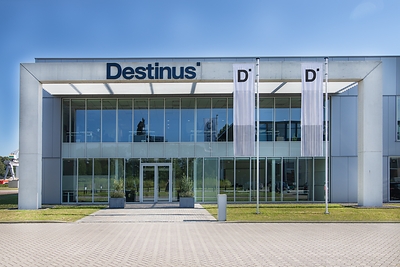
1,000th T150 turbojet engine produced in 2026 at Destinus' Hengelo facility, marking a propulsion milestone for scalable cruise missile manufacturing.
AMSTERDAM, June 18, 2026 /PRNewswire/ -- Destinus has reached a significant production milestone, completing its 1,000th T150 turbojet engine in 2026. Developed and manufactured in-house in Europe, the T150 powers the Ruta B1 and Ruta B2 cruise missile family, supporting serial production and operational deployment. The milestone strengthens Europe's ability to produce cruise-class propulsion at an industrial scale.
Propulsion remains a critical bottleneck in scalable cruise missile production. The T150 program directly addresses this constraint with a turbojet engine developed from scratch by Destinus and manufactured on a European production line built for repeatable, qualification-driven output. The engine supports current Ruta output and provides a scalable propulsion base for continued production ramp-up.
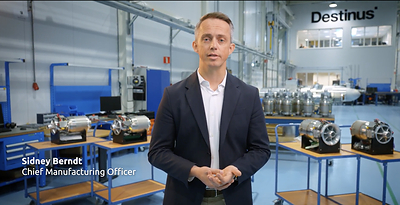
"Producing one engine is engineering. Producing a thousand is industrial capability," said Sidney Berndt, Destinus' Chief Manufacturing Officer. "The T150 was built from scratch. The design, tooling, test infrastructure, supply chain and quality control were all developed and are owned by Destinus. What you see here is not a prototype line. It is a European production system that can sustain the production of thousands of missile systems per year."
Destinus' vertically integrated approach to propulsion is central to its industrial model. By controlling engine design and manufacturing in-house, Destinus reduces dependency on external propulsion suppliers, which has historically limited European cruise missile production rates. The T150 production line is designed for continuous ramp-up, supporting both current Ruta output and planned capacity expansion, including through the Rheinmetall Destinus Strike Systems joint venture.
The production of the 1,000th engine follows Destinus' recent announcement of Ruta B3, a long-range strike system with a range of 2,000 km, powered by the next-generation T220 turbojet engine, also being developed in-house. The T150 and T220 together form a propulsion family designed to power key parts of Destinus' cruise missile portfolio.
A video marking this milestone featuring Destinus Chief Manufacturing Officer Sidney Bernt at the production facility is available at [link].
About Destinus
Destinus builds Europe's capacity to strike, defend, and replenish at scale. We design and manufacture cruise missiles, guided rockets, ballistic systems, and interceptors in Europe for European and allied armed forces. Behind these systems sits a vertically integrated base of propulsion, warheads, autonomy, and critical manufacturing. Destinus turns European engineering into sovereign military capability. Produced across Europe. Owned in Europe. Made for Europe.
Media contact
FTI Consulting: destinus@fticonsulting.com

 View original content to download multimedia:https://www.prnewswire.co.uk/news-releases/engine-no-1000-destinus-reaches-industrial-scale-turbojet-production-in-europe-302803526.html

Die Wolftank Group hat auf ihrer ordentlichen Hauptversammlung am 12. Juni 2026 den Kurs für die nächsten Jahre abgesteckt und zugleich die Kapitalmarktkompetenz im Aufsichtsrat ausgebaut. Die Aktionäre des auf Umwelttechnologien und emissionsfreie Infrastrukturlösungen spezialisierten Unternehmens stimmten allen zur Beschlussfassung vorgelegten Tagesordnungspunkten zu. Zentrale Themen waren die Präsentation des Jahresergebnisses 2025, die neue Wachstumsstrategie „GreenLead 2030“ sowie eine Satzungsänderung zur Erweiterung des Aufsichtsrats.
Mit „GreenLead 2030“ peilt die Wolftank Group nach Unternehmensangaben einen Umsatz von 250 Millionen Euro und eine EBITDA-Marge von zwölf Prozent an. Nach der Vorstellung der Ergebnisse für 2025 folgte die Hauptversammlung dem Vorschlag des Vorstands, den im Jahresabschluss zum 31. Dezember 2025 ausgewiesenen Bilanzverlust auf neue Rechnung vorzutragen. Zugleich wurden Vorstand und Aufsichtsrat für das abgelaufene Geschäftsjahr entlastet, was als Vertrauensbeweis der Aktionäre in die Unternehmensführung gewertet werden kann.
Strukturell stellte Wolftank die Weichen über eine Satzungsänderung, mit der die Höchstzahl der Aufsichtsratsmitglieder von fünf auf sechs angehoben wurde. Neben den bisherigen Mitgliedern Dr. Andreas Aufschnaiter (Vorsitz), Dr. Peter Podesser (stellvertretender Vorsitz), Dr. Peter Werth, David Hofmann und Raphaela Lindlbauer wurde erstmals Marcel Maschmeyer in das Kontrollgremium gewählt. Damit wird das Gremium um eine zusätzliche Stimme mit ausgewiesener Expertise im Investment- und Kapitalmarktbereich ergänzt.
Maschmeyer ist Vorstand der Paladin Langfrist KGaA und Geschäftsführer der Paladin Invest GmbH. Das auf börsennotierte Small- und Mid-Cap-Unternehmen spezialisierte Investmenthaus Paladin hat sein Engagement bei der Wolftank Group im vergangenen Jahr deutlich erhöht und zählt inzwischen zu den größten Aktionären des Unternehmens. Mit dem Einzug des Paladin-Vertreters in den Aufsichtsrat bindet Wolftank einen wichtigen Investor enger ein und verstärkt zugleich das Profil des Unternehmens gegenüber dem Kapitalmarkt.