LONDON, Aug. 14, 2026 /PRNewswire/ -- The ABB FIA Formula E World Championship returns to Excel London for the final two races of Season 12 (2025/26), with Hankook Tire & Technology Co., Ltd. (hereafter Hankook) supplying the entire grid at the 2026 Hankook London E-Prix on 15–16 August.
The Drivers' World Championship remains finely poised. Jake Dennis leads on 146 points, just two ahead of Mitch Evans and five clear of Pascal Wehrlein. The Teams' title will also be settled in London, with Jaguar TCS Racing holding a 14-point advantage over Porsche Formula E Team, while Porsche have already secured the Manufacturers' World Championship.
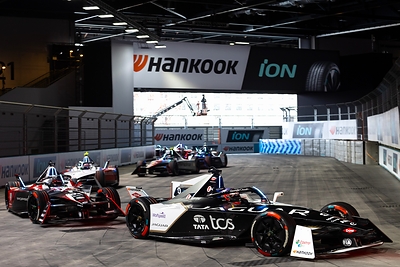
Excel London is unlike any other venue on the Formula E calendar. The 2.077-kilometre, 20-turn circuit runs through the exhibition halls at Royal Victoria Dock before moving outdoors, taking drivers from a smooth, lower-grip indoor surface onto asphalt. Changes in elevation and lighting further shape the rhythm of the short, technical lap.
With energy consumption relatively low, qualifying and track position are expected to carry added importance. The short out-lap also leaves teams with limited time to bring the tyres into their working range before a qualifying run. Across both races, teams will need to extract consistent performance from the Hankook iON Race as the cars repeatedly move between the circuit's contrasting surfaces and conditions.
"London brings several challenges together within a very short lap," said Manfred Sandbichler, Senior Director of Hankook Motorsport. "Drivers move between indoor and outdoor sections, different surfaces, changing light and elevation in quick succession. With the title fight so close, qualifying and track position will matter enormously. The iON Race was developed to perform consistently across these transitions, giving teams a stable platform on which to work throughout the weekend."
At the Formula E Hankook Fan Village booth, Hankook will showcase the winning design from its AI-powered helmet design campaign, 'Make it Yours, Make it Race,' bringing the fan-created concept to life at the season finale. Developed in collaboration with Formula E and DS PENSKE, the fan-created winning design will be produced as a full-scale racing helmet, while paper helmets featuring the artwork will be distributed to visitors throughout the weekend. Visitors will also be able to explore displays of Hankook's iON electric-vehicle tyre technology and product line-up.
Rounds 16 and 17 will begin at 15:05 local time on Saturday and Sunday. Broadcast details for each region are available on the 'How to Watch' page of the Formula E website.

 View original content to download multimedia:https://www.prnewswire.co.uk/news-releases/formula-e-title-battle-heads-to-london-with-hankook-ion-race-302851594.html

Die Artenvielfalt von Taufliegen (Drosophila) im Raum Wien ist in den vergangenen drei Jahrzehnten massiv eingebrochen. Forschende des Naturhistorischen Museums (NHM) Wien berichten, dass die Zahl der in der Stadt nachgewiesenen Arten im Vergleich zu einer Erhebung aus dem Jahr 1994 um rund 50 Prozent gesunken ist. Die Ergebnisse, die nun im Fachjournal „Ecology and Evolution“ veröffentlicht wurden, deuten darauf hin, dass vormals häufige Arten durch zugewanderte Taufliegen verdrängt worden sein könnten.
Grundlage der aktuellen Analyse ist das Citizen-Science-Projekt „Vienna City Fly“, das 2024 einfache Fliegenfallen an freiwillige Laienforscher in Wien, Niederösterreich und dem Burgenland verteilte. Die zurückgesandten Proben wurden für die nun publizierte Studie gezielt auf Fänge in unmittelbarer Nähe menschlicher Siedlungen beschränkt – also auf Innenräume, Balkone und Gärten. Damit liegt ein detailliertes Bild jener Drosophila-Gemeinschaft vor, die besonders eng an vom Menschen geprägte Lebensräume gebunden ist.
Insgesamt wurden mehr als 18.000 Taufliegen gesammelt und taxonomisch bestimmt; dabei identifizierte das Team um NHM-Forscher Martin Kapun 13 Drosophila-Arten. Bemerkenswert ist der Nachweis zweier Arten, die bislang in Österreich nicht registriert waren: Drosophila (D.) mercatorum und D. virilis. D. mercatorum ist ursprünglich in den USA, Mexiko und Südamerika verbreitet und wurde im vergangenen Jahrhundert nach Europa eingeschleppt, D. virilis stammt aus Asien und hat sich erst seit relativ kurzer Zeit über die nördliche Hemisphäre ausgebreitet.
Die Zusammensetzung der Populationen zeigt eine deutliche Verschiebung hin zu wenigen dominanten Generalisten. D. mercatorum mit rund 8.800 Nachweisen und die Modellorganismus-Art D. melanogaster mit etwa 6.700 Funden waren die mit Abstand häufigsten Spezies in den Proben. „Dominiert wird die Drosophila-Population im Wiener Stadtgebiet von Generalisten mit starker Affinität zum Menschen“, erklärte Kapun der Austria Presse Agentur zufolge. Die Ergebnisse unterstreichen, dass zunehmende Verbauung und die starke Prägung durch menschliche Siedlungen mit einem Rückgang der Biodiversität einhergehen können – auch bei unscheinbaren Insekten, die als wichtige Indikatoren für den Zustand urbaner Ökosysteme gelten.