SOMERSET, N.J., Aug. 28, 2026 /PRNewswire/ -- At a time when biopharma R&D productivity is declining and the cost of bringing a single drug to market exceeds $2.6 billion, two companies are converging capabilities to change how clinical trials are designed, sized, and executed.
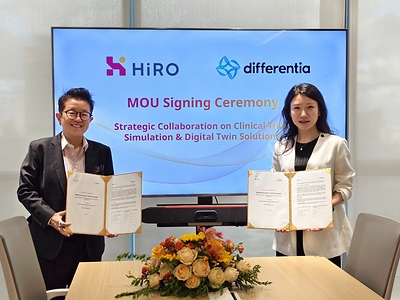
Harvest Integrated Research Organization (HiRO), a full-service global clinical research organization (CRO), and Differentia Biotech Ltd. ("Differentia"), a pioneer in knowledge-empowered modeling and simulation for drug development, today announced a Memorandum of Understanding (MOU) establishing a strategic collaboration between the two companies. The agreement was formalized at HiRO's office, marking a new step in both organizations' efforts to bring more integrated, data-driven solutions to biopharmaceutical sponsors worldwide.
Under the MOU, HiRO and Differentia will pursue collaboration across two major areas, which address the pain points of biotech companies: joint exploration and development of clinical trial simulation models that combine HiRO's global clinical operations, data science, and real-world data expertise with Differentia's AI-powered digital twin and modeling and simulation platforms; and the development of new product offerings and commercial solutions built on those combined simulation capabilities.
The clinical trial simulation collaboration sits at the center of the partnership. By pairing HiRO's operational experience running trials across oncology, rare disease, cell and gene therapy, radiopharmaceuticals, and other complex indications with Differentia's modeling and simulation platforms, the collaboration leverages simulation-informed approaches to support smarter trial design, more efficient patient selection, potential reduction in the number of subjects needed, and better-informed sponsor decision-making earlier in development.
The collaboration reflects a shared view that sponsors increasingly benefit from pairing disciplined clinical trial execution with advanced modeling and simulation, helping to inform smarter trial design, manage risk, and support timelines across complex therapeutic areas.
Chief Executive Officer and Founder of HiRO, Karen Chu said, "Drug developers don't just need faster trials, they need smarter ones. Differentia's modeling and simulation expertise complements the operational discipline HiRO brings to every study, and this collaboration lets us explore how those strengths work together for the clients we both serve. We are aiming to support our biotech clients in better decision-making."
Founder of Differentia, Shirley Wen said, "As biopharma R&D productivity continues to decline, clinical development has become an increasingly significant source of cost, time, and risk. As FDA and global regulators increasingly embrace model-informed drug development, the industry must move from 'test in humans first' toward 'simulate first, then test in humans.' Together with HiRO's clinical development expertise, we aim to improve clinical success, reduce trial size, and accelerate time to market—ultimately creating greater value and ROI for every asset."
Chief Executive Officer and Co-Founder of Differentia, Kas Subramanian said, "By fusing advanced AI and biosimulations with HiRO's industry-leading clinical research expertise, we are creating high-fidelity digital twins that will fundamentally alter the drug development paradigm, allowing biotech pioneers to de-risk assets in a virtual environment and run the most efficient trials."
HiRO and Differentia expect to share additional details on specific collaborative initiatives as the partnership progresses.
About HiRO
Harvest Integrated Research Organization (HiRO) is a full-service global CRO delivering end-to-end clinical trial services across oncology, rare diseases, dermatology, metabolic disease, and specialized modalities including cell and gene therapy and radiopharmaceuticals. With more than 30 years of collective experience serving small, mid-size, and large biotech and pharma clients, over 500 professionals, and 1,600 trials delivered across 85 countries, HiRO combines global reach with regionally informed execution across North America, Europe, APAC, and ANZ. Learn more at www.harvestiro.com.
About Differentia Biotech
Differentia Bio is a San Francisco-based technology company building the AI-powered digital twin simulation and decision intelligence platform for drug R&D and life sciences. Combining AI with quantitative biosciences, Differentia enables life science decision makers to simulate critical decisions before committing real-world time, capital, and patients. Its validated, regulatory-ready simulation capabilities help biopharma decision makers to optimize development, accelerate regulatory submissions, and improve the value of their assets and portfolios. For more information, visit www.differentiabio.com.
Media Contacts
HiRO Marketing - info@harvestiro.com
 View original content to download multimedia:https://www.prnewswire.co.uk/news-releases/hiro-and-differentia-biotech-forge-strategic-alliance-to-redefine-clinical-trial-design-through-ai-powered-simulation-302862508.html

Die Artenvielfalt von Taufliegen (Drosophila) im Raum Wien ist in den vergangenen drei Jahrzehnten massiv eingebrochen. Forschende des Naturhistorischen Museums (NHM) Wien berichten, dass die Zahl der in der Stadt nachgewiesenen Arten im Vergleich zu einer Erhebung aus dem Jahr 1994 um rund 50 Prozent gesunken ist. Die Ergebnisse, die nun im Fachjournal „Ecology and Evolution“ veröffentlicht wurden, deuten darauf hin, dass vormals häufige Arten durch zugewanderte Taufliegen verdrängt worden sein könnten.
Grundlage der aktuellen Analyse ist das Citizen-Science-Projekt „Vienna City Fly“, das 2024 einfache Fliegenfallen an freiwillige Laienforscher in Wien, Niederösterreich und dem Burgenland verteilte. Die zurückgesandten Proben wurden für die nun publizierte Studie gezielt auf Fänge in unmittelbarer Nähe menschlicher Siedlungen beschränkt – also auf Innenräume, Balkone und Gärten. Damit liegt ein detailliertes Bild jener Drosophila-Gemeinschaft vor, die besonders eng an vom Menschen geprägte Lebensräume gebunden ist.
Insgesamt wurden mehr als 18.000 Taufliegen gesammelt und taxonomisch bestimmt; dabei identifizierte das Team um NHM-Forscher Martin Kapun 13 Drosophila-Arten. Bemerkenswert ist der Nachweis zweier Arten, die bislang in Österreich nicht registriert waren: Drosophila (D.) mercatorum und D. virilis. D. mercatorum ist ursprünglich in den USA, Mexiko und Südamerika verbreitet und wurde im vergangenen Jahrhundert nach Europa eingeschleppt, D. virilis stammt aus Asien und hat sich erst seit relativ kurzer Zeit über die nördliche Hemisphäre ausgebreitet.
Die Zusammensetzung der Populationen zeigt eine deutliche Verschiebung hin zu wenigen dominanten Generalisten. D. mercatorum mit rund 8.800 Nachweisen und die Modellorganismus-Art D. melanogaster mit etwa 6.700 Funden waren die mit Abstand häufigsten Spezies in den Proben. „Dominiert wird die Drosophila-Population im Wiener Stadtgebiet von Generalisten mit starker Affinität zum Menschen“, erklärte Kapun der Austria Presse Agentur zufolge. Die Ergebnisse unterstreichen, dass zunehmende Verbauung und die starke Prägung durch menschliche Siedlungen mit einem Rückgang der Biodiversität einhergehen können – auch bei unscheinbaren Insekten, die als wichtige Indikatoren für den Zustand urbaner Ökosysteme gelten.