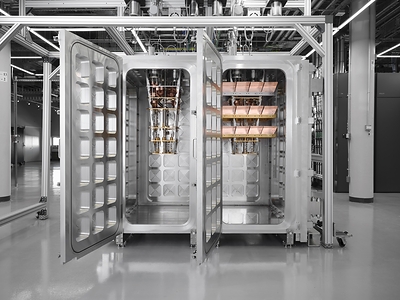
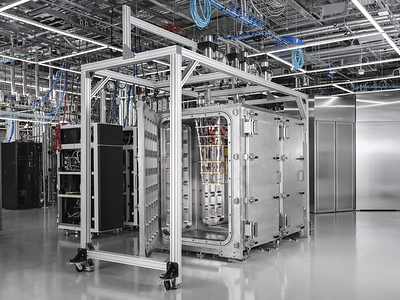
YORKTOWN HEIGHTS, N.Y., Aug. 19, 2026 /PRNewswire/ -- IBM (NYSE: IBM) today announced it has successfully joined and cooled down two cryogenic modules into a single environment. The new architecture is designed to scale into the modular, shared, and ultra-cold system required to link hundreds of quantum chips into a more powerful quantum computer capable of solving large problems. Its deployment is a milestone on IBM's path to delivering IBM Quantum Starling in 2029, which is expected to be the world's first fault-tolerant quantum computer and will integrate advances across error correction, processor design, decoding, and systems engineering.
Combined, the first two operational modules stand more than 8 feet tall and 8 feet wide, and initial tests demonstrated they can jointly cool down to 4 Kelvin (the temperature of liquid helium) in under 5 days, reaching a final temperature of below 15 millikelvin shortly after. Each module's vacuum enclosure offers up to 12 times more wiring space than the most widely used IBM quantum systems, enabling more chip-to-chip connections both within and between modules.
IBM's new box-shaped design allows modules to connect in a tight row and use this larger space to directly link quantum processors with IBM's "L-coupler" technology. L-couplers connect separate quantum chips together to share information, communicate, and operate as part of a larger quantum computer.
By 2027, IBM's quantum roadmap plans to use L-couplers to link multiple processors into a larger quantum computer with at least 1,000 programmable qubits, which are qubits that can be directly used to perform computations. Towards this goal, IBM will install IBM Quantum Nighthawk processors into the cryogenic modules later this year to expand operational performance testing. At the time Starling is delivered, IBM plans for each cryogenic module to house thousands of qubits.
IBM's plans for Starling were introduced last year with a new error correction code that dramatically reduces the physical resources required for fault tolerance. Since then, the company's progression has remained on course, including the demonstration of core hardware components and breakthroughs in efficient error-correction decoding.
"Bringing fault-tolerant quantum computers to industries depends on several fundamental advances," said Jay Gambetta, Director of IBM Research and IBM Fellow. "The successful connection and operation of these cryogenic modules signals a leap forward in that direction and will accelerate our progress alongside continued innovation in quantum hardware, software, and algorithms."
IBM expects its scalable cryogenic modules to help speed its pace of innovation. For example, three essential components of IBM Quantum System Two's environment are built into the new architecture, but now in a way that allows each part to be independently tested, improved, and rapidly iterated.
The delivery of these new cryogenic quantum modules is further evidence that IBM is systematically delivering against its quantum roadmap, solving another one of the major hurdles required to accelerate its path to fault-tolerant quantum computing.
About IBM
IBM is a leading provider of global hybrid cloud and AI, and consulting expertise. We help clients in more than 175 countries capitalize on insights from their data, streamline business processes, reduce costs and gain the competitive edge in their industries. Thousands of governments and corporate entities in critical infrastructure areas such as financial services, telecommunications and healthcare rely on IBM's hybrid cloud platform and Red Hat OpenShift to affect their digital transformations quickly, efficiently and securely. IBM's breakthrough innovations in AI, quantum computing, industry-specific cloud solutions and consulting deliver open and flexible options to our clients. All of this is backed by IBM's long-standing commitment to trust, transparency, responsibility, inclusivity and service. Visit www.ibm.com for more information.
Media contacts:
Dave Mosher
IBM
dave.mosher@ibm.com
Erin Angelini
IBM
edlehr@us.ibm.com

 View original content to download multimedia:https://www.prnewswire.co.uk/news-releases/ibm-connects-its-first-modular-cryogenic-systems-in-milestone-toward-fault-tolerant-quantum-computing-302854646.html

Auf einer der wichtigsten Bahnachsen Ostbayerns ruht für ein halbes Jahr der reguläre Zugverkehr. Die DB InfraGO hat die Korridorsanierung der Strecke Obertraubling–Passau gestartet und die Verbindung weitgehend voll gesperrt. Von diesem Sonntag an bis zum Fahrplanwechsel am 12. Dezember wird die Infrastruktur auf rund 120 Kilometern umfassend erneuert. Das Investitionsvolumen liegt nach Bahnangaben bei rund 1,3 Milliarden Euro inklusive Risikopuffer.
Die Arbeiten schließen unmittelbar an die seit Anfang Februar laufende Generalsanierung der stark befahrenen Strecke Nürnberg–Regensburg an, die bis 10. Juli abgeschlossen sein soll. Auf dem Abschnitt bis Passau erneuert die Bahn Gleise, mehr als 140 Weichen und etwa 90 Kilometer Oberleitungen. Mehrere Stellwerke werden ersetzt oder instand gesetzt, veraltete Relais‑Technik weicht moderner Elektronik. Hinzu kommen eine Eisenbahnüberführung und fünf Personenunterführungen; im Bereich Osterhofen muss an einer Moorstelle nahe der Donau der Untergrund aufwendig verfestigt werden. Acht Bahnhöfe werden modernisiert und mit höheren Bahnsteigen schrittweise barrierefrei ausgebaut – Arbeiten, die bis ins Frühjahr 2027 hineinreichen.
Für Reisende hat die Sanierung gravierende Folgen. Im Nahverkehr richtet die Bahn zusammen mit der Bayerischen Eisenbahngesellschaft ein dichtes Netz an Schienenersatzverkehr ein. Rund 90 Busse sind auf sechs Linien unterwegs; sie und die Wegweiser sind in auffälligem Purpur gestaltet, um die Orientierung zu erleichtern. Im Fernverkehr entfallen die Züge zwischen Nürnberg beziehungsweise Regensburg und Passau sowie weiter nach Wien komplett. Fahrgäste Richtung Österreich werden auf Verbindungen über München verwiesen, zusätzliche Züge über Mühldorf und Salzburg sowie ein Ersatzbusangebot für Passauer Fernreisende sollen die Auswirkungen abfedern.
Aus der Politik kommt grundsätzliche Unterstützung, zugleich aber auch der Hinweis auf die Belastungen für Region und Wirtschaft. Der Parlamentarische Staatssekretär Ulrich Lange betonte, wer eine leistungsfähige, verlässliche Bahn wolle, müsse jetzt entschlossen modernisieren; am Ende profitierten Fahrgäste und Wirtschaftsstandort. Bayerns Verkehrsminister Christian Bernreiter sprach mit Blick auf den kurzen Abstand zur Baustelle Nürnberg–Regensburg von einer zweiten großen Belastung binnen kürzester Zeit für Fahrgäste und Unternehmen in Ostbayern. Für die Bahn ist der Korridor zwischen Regensburg und Passau zugleich Testfeld für die Strategie, ganze Streckenabschnitte in gebündelten Sperrpausen grundlegend zu erneuern, um langfristig die Pünktlichkeit zu verbessern.