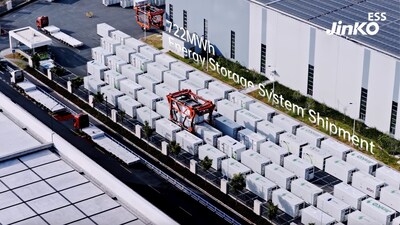
SHANGHAI, June 10, 2026 /PRNewswire/ -- Recently, Jinko ESS, a leading global energy storage company and a subsidiary of JinkoSolar Co., Ltd., completed the delivery of 722MWh energy storage system equipment for a large-scale renewable energy base project in India. The project adopts 144 sets of Jinko SunTera G2 liquid-cooling energy storage systems, providing reliable storage support for high-proportion renewable energy grid integration, clean energy dispatch, grid stability, and peak load management. As an energy storage system solutions provider, Jinko ESS not only delivers highly reliable products, but also provides system integration, project delivery, and long-term service support tailored to different application scenarios.
As large-scale renewable energy bases move into high-proportion grid connection and stable operation, energy storage is becoming critical infrastructure for ensuring asset operation quality and grid flexibility. Compared with conventional scenarios, such projects place higher requirements on system safety, environmental adaptability, delivery execution, and long-term service response.
The project site features typical complex conditions, including high temperature, high humidity, heavy dust, strong sunlight, and long-distance transportation. These conditions require higher standards for structural design, thermal management, protection rating, safety architecture, and on-site support. The successful delivery of this 722MWh system further demonstrates Jinko ESS's capability in utility-scale energy storage delivery under complex environments.
To meet these demands, Jinko SunTera G2 adopts advanced liquid-cooling temperature control technology, keeping cell temperature difference within 2.5°C to improve operating consistency, efficiency, and long-term reliability. The system supports stable operation under temperatures up to 55°C and 99% humidity. With an IP55 protection rating, anti-corrosion design, multi-layer safety protection, and intelligent thermal management, SunTera G2 provides safe, stable, and sustainable energy storage support for large-scale renewable energy bases.
For utility-scale storage projects, equipment delivery is only the starting point. Long-term stable operation is key to realizing customer asset value. Leveraging its integrated capabilities across cells, PACK, system integration, and global project delivery, Jinko ESS provides full-lifecycle support covering system solutions, product delivery, on-site service, and long-term O&M collaboration. In addition, Jinko ESS's AI-powered EMS can support real-time monitoring, operating status management, load forecasting, and charge-discharge strategy optimization, helping customers improve renewable energy consumption efficiency, grid response capability, and asset operation value.
Anita Li, Vice President of Jinko ESS, said: "Large-scale renewable energy bases are placing higher requirements on energy storage systems. Energy storage is not only about capacity configuration, but also closely related to project safety, dispatch capability, and long-term returns. The delivery of this 722MWh system is another important practice for Jinko ESS in large-scale complex scenarios. We will continue to support customers with reliable products, robust delivery capabilities, and long-term service support, helping build a more stable, flexible, and sustainable clean energy system."
As an energy storage system solutions provider, Jinko ESS will continue to support global large-scale energy storage infrastructure with reliable products, system integration, project delivery, and long-term service capabilities, providing a more stable, flexible, and sustainable foundation for the clean energy transition.
Photo - https://mma.prnewswire.com/media/2996412/Jinko_ESS_India.jpg
 View original content:https://www.prnewswire.co.uk/news-releases/jinko-ess-delivers-722mwh-bess-for-indias-large-scale-power-plant-302796077.html

Die österreichische Steyr Motors AG baut ihr Geschäft im Bereich autonomer Verteidigungs- und Sicherheitssysteme aus und setzt damit auf einen der am schnellsten wachsenden Segmente der Rüstungsindustrie. Nach bereits realisierten Anwendungen in unbemannten Überwasserfahrzeugen (USV) kommen die Hochleistungsmotoren des Unternehmens nun auch in modernen unbemannten Bodenfahrzeugen (Unmanned Ground Vehicles, UGV) zum Einsatz. Im Zentrum steht dabei die Plattform CORNUS des slowenischen Spezialisten RTC, die künftig mit Antriebstechnologie von Steyr Motors ausgestattet wird.
Das CORNUS-UGV ist als modulare Plattform für anspruchsvolle Einsätze in militärischen und sicherheitsrelevanten Umgebungen ausgelegt. Es lässt sich flexibel für unterschiedliche Missionen konfigurieren, darunter Aufklärungsaufgaben, Logistiktransporte in schwierigem Gelände, die mobile Energieversorgung im Feld sowie die unmittelbare Unterstützung von Einsatzkräften. In all diesen Anwendungen sind Zuverlässigkeit, Robustheit und Ausfallsicherheit zentrale Anforderungen – Bereiche, in denen Steyr Motors auf jahrzehntelange Erfahrung aus Marine-, Spezialfahrzeug- und Defense-Anwendungen verweist.
Der Schritt in den UGV-Markt erfolgt vor dem Hintergrund eines breiten Trends hin zu autonomen und unbemannten Systemen. Weltweit investieren Streitkräfte verstärkt in autonome Aufklärungsplattformen, unbemannte Logistikfahrzeuge, ferngesteuerte Schutzsysteme und maritime Robotik, um Risiken für Soldaten zu verringern und gleichzeitig die operative Leistungsfähigkeit zu erhöhen. Ein jüngstes Beispiel für die wachsende Bedeutung solcher Technologien ist eine US-Rettungsaktion in der Straße von Hormus, bei der unbemannte Überwasserfahrzeuge zum Einsatz kamen und damit die Relevanz autonomer Fahrzeugplattformen unterstrichen haben.
Branchenanalysen veranschlagen das Volumen des globalen Marktes für unbemannte Systeme bis zum Jahr 2033 auf mehr als 67 Milliarden US-Dollar. Steyr Motors sieht sich als Technologiezulieferer gut positioniert, um von dieser Entwicklung zu profitieren. Das Unternehmen betont, dass das Wachstumspotenzial aus autonomen Defense-Lösungen im aktuellen Auftragsbestand erst in Ansätzen abgebildet ist. Der Einstieg in das CORNUS-Programm gilt vor diesem Hintergrund als weiterer Baustein, um die Präsenz im Zukunftsmarkt unbemannter Systeme deutlich auszubauen.