ULAANBAATAR, Mongolia, Aug. 24, 2026 /PRNewswire/ -- From August 17 to 28, 2026, the 17th session of the Conference of the Parties to the United Nations Convention to Combat Desertification (UNCCD COP17) is being held in Ulaanbaatar, Mongolia. During the conference, LONGi participated in several side events, systematically presenting the enormous potential of PV technology to enhance the resilience of global food supply, and officially released its solutions for PV-powered food security.
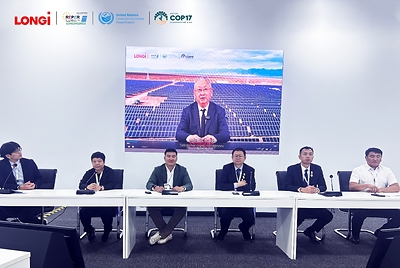
At a side event titled "From Desert to Asset – Comprehensive Solutions for Integrated PV-Based Ecological Restoration," co-hosted by the School of Social Sciences of Tsinghua University and the China Green Foundation, Li Zhenguo, founder and Chief Technology Officer of LONGi, joined via video link and noted that traditional food production relies heavily on natural photosynthesis and climatic conditions. Extreme weather events such as droughts and floods have severely impacted agricultural production, and global climate change is placing unprecedented pressure on an already fragile food supply system. However, as costs decline, PV technology can not only reduce carbon emissions but also offer a new solution for enhancing the resilience of global food supply.
Li Zhenguo recently published a forward-looking Perspective article titled "Photovoltaics for food security" in the leading international academic journal Nature Sustainability, in which he systematically set out two technological pathways with practical application prospects.
Pathway 1: PV-driven artificial synthesis of starch from carbon dioxide. PV-generated electricity is used to electrolyze water and produce green hydrogen, which is then coupled with captured CO₂ to synthesize green methanol. This methanol is subsequently converted into starch through oxidation, polymerization, and other processes. Compared with the solar energy utilization efficiency of about 2% in traditional natural photosynthesis, this pathway can raise efficiency to 7–10%. Calculations show that deploying PV on just 3.7% of the Sahara Desert could generate 26 trillion kWh of green electricity, enough to synthesize 3 billion tonnes of food and meet the current global food demand.
Pathway 2: PV-driven "energy-water-food" nexus system. By building PV power plants in desert areas, the shading effect of PV modules reduces soil moisture evaporation, improves the soil microclimate, and lowers irrigation requirements. Combined with PV-powered seawater desalination and inter-regional water transfer projects, this approach can gradually transform desert land that was previously unsuitable for cultivation into arable farmland.
In fact, LONGi has already been actively exploring this approach in the Kubuqi Desert in Inner Mongolia, China – generating electricity on the panels, planting crops under the panels, and raising livestock between the panel rows. Under the PV panels, the once barren land is being revitalized. This practice verifies the feasibility of integrated PV-ecology-agriculture development and provides a replicable Chinese solution for the coordinated development of ecological restoration and food production in desertification-prone areas.
The theme of this year's COP17 is "Restoring Land, Restoring Hope." LONGi actively participated in multiple side events, engaging in in-depth exchanges with government agencies, scientists, and corporate representatives from around the world, and sharing Chinese experience in the deep integration of PV with desertification control and ecological restoration.
From cutting-edge laboratory exploration to on-the-ground validation in deserts, PV is evolving from an energy solution into a cornerstone of sustainable development. Looking ahead, LONGi will leverage Solar (PV)-plus-Storage technologies to actively address climate change, continue to promote the deep integration of PV with ecology, agriculture, water resources and other fields, build a more resilient global sustainable development system, and ensure that more affordable, safer, and more accessible green energy truly benefits everyone.

 View original content to download multimedia:https://www.prnewswire.co.uk/news-releases/longi-at-unccd-cop17-li-zhenguo-explains-two-technological-pathways-for-pv-powered-food-security-302857978.html

Die österreichische Steyr Motors AG baut ihr Geschäft im Bereich autonomer Verteidigungs- und Sicherheitssysteme aus und setzt damit auf einen der am schnellsten wachsenden Segmente der Rüstungsindustrie. Nach bereits realisierten Anwendungen in unbemannten Überwasserfahrzeugen (USV) kommen die Hochleistungsmotoren des Unternehmens nun auch in modernen unbemannten Bodenfahrzeugen (Unmanned Ground Vehicles, UGV) zum Einsatz. Im Zentrum steht dabei die Plattform CORNUS des slowenischen Spezialisten RTC, die künftig mit Antriebstechnologie von Steyr Motors ausgestattet wird.
Das CORNUS-UGV ist als modulare Plattform für anspruchsvolle Einsätze in militärischen und sicherheitsrelevanten Umgebungen ausgelegt. Es lässt sich flexibel für unterschiedliche Missionen konfigurieren, darunter Aufklärungsaufgaben, Logistiktransporte in schwierigem Gelände, die mobile Energieversorgung im Feld sowie die unmittelbare Unterstützung von Einsatzkräften. In all diesen Anwendungen sind Zuverlässigkeit, Robustheit und Ausfallsicherheit zentrale Anforderungen – Bereiche, in denen Steyr Motors auf jahrzehntelange Erfahrung aus Marine-, Spezialfahrzeug- und Defense-Anwendungen verweist.
Der Schritt in den UGV-Markt erfolgt vor dem Hintergrund eines breiten Trends hin zu autonomen und unbemannten Systemen. Weltweit investieren Streitkräfte verstärkt in autonome Aufklärungsplattformen, unbemannte Logistikfahrzeuge, ferngesteuerte Schutzsysteme und maritime Robotik, um Risiken für Soldaten zu verringern und gleichzeitig die operative Leistungsfähigkeit zu erhöhen. Ein jüngstes Beispiel für die wachsende Bedeutung solcher Technologien ist eine US-Rettungsaktion in der Straße von Hormus, bei der unbemannte Überwasserfahrzeuge zum Einsatz kamen und damit die Relevanz autonomer Fahrzeugplattformen unterstrichen haben.
Branchenanalysen veranschlagen das Volumen des globalen Marktes für unbemannte Systeme bis zum Jahr 2033 auf mehr als 67 Milliarden US-Dollar. Steyr Motors sieht sich als Technologiezulieferer gut positioniert, um von dieser Entwicklung zu profitieren. Das Unternehmen betont, dass das Wachstumspotenzial aus autonomen Defense-Lösungen im aktuellen Auftragsbestand erst in Ansätzen abgebildet ist. Der Einstieg in das CORNUS-Programm gilt vor diesem Hintergrund als weiterer Baustein, um die Präsenz im Zukunftsmarkt unbemannter Systeme deutlich auszubauen.