New agentic AI capability continuously monitors selected industries and topics, giving business leaders a current view of market change without requiring a dedicated analyst team.
BERLIN, Sept. 16, 2026 /PRNewswire/ -- Market Logic Software today announced the general availability of DeepSights Radar, a new capability in its AI-powered market intelligence platform, DeepSights. DeepSights Radar autonomously monitors, analyzes and synthesizes developments across selected industries and topics, helping companies spot market developments before they become urgent risks or missed opportunities.
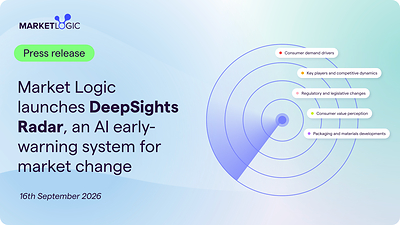
Insights teams are under pressure to follow more sources, competitors and market signals, often without additional headcount. The result is a growing gap between the volume of information available and the capacity to turn it into timely intelligence for business stakeholders in strategy, product, innovation and marketing. DeepSights Radar is designed to help close that gap by providing 24/7 access to an up-to-date view of strategic markets and topics from one place.
Expert AI agents analyze new market signals
AI agents that keep a living picture of the market
DeepSights Radar uses always-on AI agents that read every piece of research flowing into a customer's DeepSights platform against a definition of what matters to that business, in its own vocabulary. Rather than summarizing a fixed set of documents, the agents build up a living body of market understanding: they recognize the competitors, trends, regulatory developments and other forces that qualify, and maintain a structured, multi-chapter profile on each. Every new piece of research deepens that understanding, with every claim traceable to its source. A New Learnings summary highlights what has changed since the last version, so users can easily read about the shift rather than going over the entire profile from scratch.
Two ways to monitor: industry radar and topic radar
DeepSights Radar is available in two modes: Industry Radar and Topic Radar.
Industry Radar tracks change across a vertical market and identifies emerging trends and issues customers may not yet be following. Market Logic is launching with three out-of-the-box industry radars: consumer packaged goods (CPG), over the counter (OTC) healthcare and retail. Each radar is pre-tuned to the industry's acronyms, dynamics and KPIs and includes 12 ready-to-use radars organized around four dimensions: demand, supply, regulatory and legislative change, and competitive activity. With expert services support, new Industry Radars can go live within a few days.
Topic Radar provides ongoing monitoring of specific themes and topics a customer has identified as strategically important. A self-service setup, guided by a short briefing wizard, allows companies to set a new radar live within hours.
Built for active intelligence
The Radar launch reflects Market Logic's focus on active intelligence: AI-supported systems that identify new market signals, alert users to important developments and help teams act earlier on evidence rather than intuition.
"Business and insights leaders do not lack data. They lack the time and resources to turn it into a dependable, current view of their market. DeepSights Radar does that continuously, so they can act early and seize competitive advantage," said Olaf Lenzmann, Chief Product and Innovation Officer, Market Logic Software.
DeepSights Radar is generally available for new and existing DeepSights customers.
About Market Logic Software
Market Logic Software is a provider of pioneering market intelligence and insights solutions. Its AI-enabled platform, DeepSights, helps organizations make research and market intelligence available to decision-makers across the enterprise at scale and speed. For more than 15 years, Market Logic has worked with consumer-focused brands around the world to support insights-driven decision-making. Customers include Vodafone, Bayer and Philips. More information is available at https://marketlogicsoftware.com.

 View original content to download multimedia:https://www.prnewswire.co.uk/news-releases/market-logic-software-launches-deepsights-radar-an-ai-early-warning-system-for-market-change-302880205.html

Ein umfangreicher Auswertungsbericht der Wirtschafts- und Korruptionsstaatsanwaltschaft (WKStA) zu digitalen Daten des verstorbenen Justiz-Spitzenbeamten Christian Pilnacek sorgt für neuen politischen und justizinternen Sprengstoff. Chatprotokolle, E-Mails und weitere Unterlagen zeichnen ein Bild tiefgreifender Konflikte innerhalb der Justiz – insbesondere zwischen der WKStA und Teilen der vorgesetzten Behörden. Parallel dazu bereitet ein parlamentarischer Untersuchungsausschuss die Befragung von Schlüsselpersonen vor, um mögliche politische Einflussnahmen auf Ermittlungen rund um Pilnacek und dessen Tod zu beleuchten.
Aus der von der WKStA erstellten Expertise zu Pilnaceks Kommunikationsdaten geht hervor, wie der langjährige Leiter der für Strafrecht zuständigen Sektion im Justizministerium über Jahre hinweg gegenüber der WKStA Stellung bezog. Der Bericht zeigt, dass der damalige Wiener Oberstaatsanwaltschef Johann Fuchs im Juni 2019 in einer internen Nachricht erklärte, er sehe es als Aufgabe seiner Amtszeit, eine von der WKStA angeblich offengelegte „Verkommenheit“ im Berufsstand „mit allen Mitteln zu bekämpfen“. Er bezeichnete Pilnacek darin ausdrücklich als Mitstreiter. In dem Gutachten findet sich zudem Material, aus dem hervorgehen soll, wie die Korruptionsstaatsanwaltschaft aufgelöst und neu aufgesetzt werden könnte.
Die Auswertung des Laptops und mehrerer Speichermedien Pilnaceks, die in einem rund 440 Seiten starken Bericht zusammengefasst wurde, behandelt auch seine Kontakte in das Umfeld der ÖVP. Der frühere Sektionschef war von 2010 bis 2020 über alle wesentlichen Strafsachen der Republik informiert und konnte als weisungsbefugter Beamter Ermittlungsschritte mitsteuern oder Berichte anfordern. Laut dem Bericht kooperierte er in dieser Zeit eng mit ÖVP-nahen Personen und wirkte an der Verteidigung von Beschuldigten mit. Nach Bekanntwerden einer Audioaufnahme aus dem Sommer 2023, in der Pilnacek Interventionen von ÖVP-Seite beklagte, leitete die WKStA ein Ermittlungsverfahren gegen unbekannte Täter ein; dieser Interventionsakt ist nun ebenfalls Gegenstand des U-Ausschusses.
Der Untersuchungsausschuss, der sich mit den Umständen von Pilnaceks Tod und dem Umgang der Behörden befasst, bekommt das WKStA-Dokument zeitlich passend zur nächsten Befragungsrunde vorgelegt. Zunächst soll ein IT-Experte der WKStA, der für das Auslesen von Datenträgern zuständig ist, Auskunft geben. In den darauffolgenden Tagen werden Exekutivbeamte befragt, darunter der Leiter des Bundeskriminalamts sowie zwei Polizeibeamte aus Niederösterreich, die unter anderem mit Pilnaceks Geisterfahrt Stunden vor dem Fund seiner Leiche in einem Donau-Seitenarm befasst waren. Politisch besonders im Fokus steht der Auftritt von Innenminister Gerhard Karner und dessen Kabinettschefin, nachdem eine vom Ressort in Auftrag gegebene Schulungsunterlage für geladene Auskunftspersonen parteiübergreifend – mit Ausnahme der ÖVP – auf Kritik gestoßen war.
Die Kombination aus internen Justizchats, detaillierter Datenauswertung und politischer Aufarbeitung im Parlament verschärft die Debatte über das Verhältnis zwischen Ministerien, Staatsanwaltschaften und Parteien. Während die WKStA ihre Auswertungsergebnisse in den U-Ausschuss einbringt, suchen Abgeordnete nach Antworten auf die Frage, ob und in welchem Ausmaß versucht wurde, auf Ermittlungen Einfluss zu nehmen – sowohl in prominenten Wirtschafts- und Korruptionsfällen als auch im Zusammenhang mit den Untersuchungen nach dem Tod eines der einflussreichsten Justizbeamten der vergangenen Jahre.