CLARK, N.J., June 10, 2026 /PRNewswire/ -- GEP Global Supply Chain Volatility Index, based on a monthly survey of 27,000 businesses, signaled continued pressure on global supply chains in May as manufacturers increased purchases and built safety stocks to protect against rising inflation.

Reports of safety stockpiling rose to their highest level since January 2023, as companies bulk ordered goods and raw materials ahead of expected price increases and potential supply disruption. This front-loaded purchasing pushed global demand for inputs to its strongest since March 2022.
Shortages also worsened in May, reaching their highest level in three-and-a-half years. Combined with elevated transportation costs, the data shows that supply chain pressures are no longer limited to shipping and energy markets.
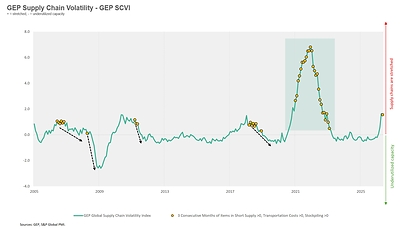
May's data also points to a rare pattern: for three consecutive months, stockpiling, shortages and transportation costs have all been elevated. Outside the 2021-23 supply chain crisis, this has typically been followed by a sharp fall in the index as supply chains self-correct (see chart below), often through weaker input demand or deteriorating economic conditions.
"The path for inflation is already being set, and companies are trying to limit the damage," said John Piatek, vice president, consulting, GEP. "The surge in purchasing we saw in April and May is likely temporary. Once companies have built inventory, they and their customers will pull back, which means supply chain pressures may ease. But, even if the Strait of Hormuz is opened fully, economic conditions will likely weaken in the second half of the year as companies will pull back on their input purchasing to draw down the inventories they've built up."
Interpreting the data:
Index > 0, supply chain capacity is being stretched. The further above 0, the more stretched supply chains are.
Index < 0, supply chain capacity is being underutilized. The further below 0, the more underutilized supply chains are.
MAY 2026 REGIONAL KEY FINDINGS
MAY 2026 KEY FINDINGS
For more information, visit www.gep.com/volatility.
Note: Full historical data dating back to January 2005 is available for subscription. Please contact economics@spglobal.com.
The next release of the GEP Global Supply Chain Volatility Index will be 8 a.m. ET, JuL. 13, 2026.
About the GEP Global Supply Chain Volatility Index
The GEP Global Supply Chain Volatility Index is produced by S&P Global and GEP. It is derived from S&P Global's PMI® surveys, sent to companies in over 40 countries, totaling around 27,000 companies. The headline figure is a weighted sum of six sub-indices derived from PMI data, PMI Comments Trackers and PMI Commodity Price & Supply Indicators compiled by S&P Global.
A Supply Chain Volatility Index is also published at a regional level for Europe, Asia, North America and the U.K. For more information about the methodology, click here.
Media Contacts
Derek Creevey | Joe Hayes | S&P Global Market Intelligence | |
Director, Public Relations | Principal Economist | Corporate Communications | |
GEP | S&P Global Market Intelligence | Email: Press.mi@spglobal.com | |
Phone: +1 646-276-4579 | Phone: +44-1344-328-099 | ||
Email: derek.creevey@gep.com | Email: joe.hayes@spglobal.com |

 View original content to download multimedia:https://www.prnewswire.co.uk/news-releases/safety-stockpiling-hits-highest-level-in-over-three-years-as-businesses-rush-to-protect-against-inflation-and-shortages-gep-global-supply-chain-volatility-index-302794584.html

Auf einer der wichtigsten Bahnachsen Ostbayerns ruht für ein halbes Jahr der reguläre Zugverkehr. Die DB InfraGO hat die Korridorsanierung der Strecke Obertraubling–Passau gestartet und die Verbindung weitgehend voll gesperrt. Von diesem Sonntag an bis zum Fahrplanwechsel am 12. Dezember wird die Infrastruktur auf rund 120 Kilometern umfassend erneuert. Das Investitionsvolumen liegt nach Bahnangaben bei rund 1,3 Milliarden Euro inklusive Risikopuffer.
Die Arbeiten schließen unmittelbar an die seit Anfang Februar laufende Generalsanierung der stark befahrenen Strecke Nürnberg–Regensburg an, die bis 10. Juli abgeschlossen sein soll. Auf dem Abschnitt bis Passau erneuert die Bahn Gleise, mehr als 140 Weichen und etwa 90 Kilometer Oberleitungen. Mehrere Stellwerke werden ersetzt oder instand gesetzt, veraltete Relais‑Technik weicht moderner Elektronik. Hinzu kommen eine Eisenbahnüberführung und fünf Personenunterführungen; im Bereich Osterhofen muss an einer Moorstelle nahe der Donau der Untergrund aufwendig verfestigt werden. Acht Bahnhöfe werden modernisiert und mit höheren Bahnsteigen schrittweise barrierefrei ausgebaut – Arbeiten, die bis ins Frühjahr 2027 hineinreichen.
Für Reisende hat die Sanierung gravierende Folgen. Im Nahverkehr richtet die Bahn zusammen mit der Bayerischen Eisenbahngesellschaft ein dichtes Netz an Schienenersatzverkehr ein. Rund 90 Busse sind auf sechs Linien unterwegs; sie und die Wegweiser sind in auffälligem Purpur gestaltet, um die Orientierung zu erleichtern. Im Fernverkehr entfallen die Züge zwischen Nürnberg beziehungsweise Regensburg und Passau sowie weiter nach Wien komplett. Fahrgäste Richtung Österreich werden auf Verbindungen über München verwiesen, zusätzliche Züge über Mühldorf und Salzburg sowie ein Ersatzbusangebot für Passauer Fernreisende sollen die Auswirkungen abfedern.
Aus der Politik kommt grundsätzliche Unterstützung, zugleich aber auch der Hinweis auf die Belastungen für Region und Wirtschaft. Der Parlamentarische Staatssekretär Ulrich Lange betonte, wer eine leistungsfähige, verlässliche Bahn wolle, müsse jetzt entschlossen modernisieren; am Ende profitierten Fahrgäste und Wirtschaftsstandort. Bayerns Verkehrsminister Christian Bernreiter sprach mit Blick auf den kurzen Abstand zur Baustelle Nürnberg–Regensburg von einer zweiten großen Belastung binnen kürzester Zeit für Fahrgäste und Unternehmen in Ostbayern. Für die Bahn ist der Korridor zwischen Regensburg und Passau zugleich Testfeld für die Strategie, ganze Streckenabschnitte in gebündelten Sperrpausen grundlegend zu erneuern, um langfristig die Pünktlichkeit zu verbessern.