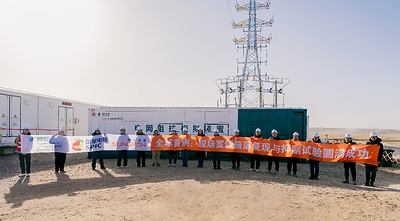
HEFEI, China, Sept. 17, 2026 /PRNewswire/ -- Sungrow, a globally leading PV inverter and energy storage system provider, recently has achieved a world first by controllably reproducing and successfully suppressing wideband oscillation at a real-world 500 MW solar-plus-storage plant in Qinghai, China. The field test marks a major step toward addressing one of the long-standing challenges facing renewable power systems as renewable penetration continues to increase worldwide.
As renewable penetration rises worldwide, wideband oscillation has become a major challenge, with severe cases potentially causing renewable plants to disconnect from the grid or shut down. In 2014, the BorWin1 offshore HVDC project in Germany experienced oscillations at 250–350 Hz, which damaged filter capacitors on the offshore converter platform and led to a shutdown lasting approximately six months, causing substantial economic losses to the local utility. In 2019, the Hornsea offshore wind farm in the UK experienced widespread disconnection due to subsynchronous oscillation, resulting in a loss of approximately 3.2% of the system load and affecting around one million users. Past incidents have demonstrated the significant impact of oscillation-related events.
However, the complex and unpredictable nature of the phenomenon has made it difficult to safely and controllably reproduce oscillations at real-world plants and validate effective suppression methods in the field. As a result, research has largely remained at the theoretical and simulation stage, with limited systematic validation in actual power plant environments.
To bridge this gap, Sungrow and its industry partners conducted a field test at the plant, using Sungrow PV inverters deployed across the site.
Controlled Reproduction of Wideband Oscillation
The test established weak-grid conditions and identified three key contributing factors—power output, system short-circuit ratio (SCR), and control parameters—before successfully achieving controlled reproduction of a localized system oscillation.
Rapid Suppression of Wideband Oscillation
The field test evaluated the oscillation suppression performance of Sungrow's PV inverters under different grid conditions. Leveraging Sungrow's patented grid-strength adaptation technology, the inverters identified grid strength within 40 milliseconds, adjusted their control strategies accordingly, and rapidly stabilized voltage and frequency.
The test also validated the effectiveness of grid-forming control in suppressing wideband oscillation. Sungrow's grid-forming control strategy enables stable operation across a wide SCR range of 1~40 and effectively mitigates transient overvoltage.
By successfully reproducing and suppressing wideband oscillation at a real-world 500MW plant, the field test marks a critical step in moving wideband oscillation suppression from the laboratory into engineering practice, with the potential to improve the stability of renewable energy plants under extremely weak grid conditions, prevent grid disconnections caused by oscillations, unlock greater power export capacity for plants connected to weak grids, and reduce generation losses.
"For renewable energy to become a truly stable and reliable source of power, it is essential to develop autonomous fault self-healing and grid-support capabilities." Pan Nian'an, Chief Engineer and Chief Expert for Utility PV BU at Sungrow, said Sungrow will continue to advance research and development in grid technologies, focusing on key innovations including wideband oscillation suppression, grid-forming control, and multi-energy coordination. These efforts aim to support the stable grid integration and efficient utilization of renewable energy while strengthening the technical foundation for a secure and stable energy transition and next-generation power systems.

 View original content to download multimedia:https://www.prnewswire.co.uk/news-releases/sungrow-achieves-world-first-wideband-oscillation-reproduction-and-suppression-at-500-mw-plant-302881815.html

Vorarlbergs Landeshauptmann Markus Wallner (ÖVP) hat die innenpolitische Debatte über den Umgang mit Jugendkriminalität und die Ausgestaltung des Sozialsystems neu angeheizt. In der ORF-„Pressestunde“ brachte der Vorsitzende der Landeshauptleutekonferenz die seit Jahren umstrittene Forderung seiner Partei erneut auf den Tisch, die Strafmündigkeit in Österreich von derzeit 14 auf zwölf Jahre zu senken. „Wer früh Grenzen übertritt, der muss auch damit rechnen, dass früh Grenzen aufgezeigt werden“, sagte Wallner. Allein mit Strafrecht sei es aus seiner Sicht jedoch nicht getan; parallel brauche es ein „Netz an verpflichtenden Unterstützungen“ für betroffene Kinder und Familien.
Zur Begründung verwies Wallner auf Entwicklungen in Schweden. Dort werde über Gefängnisstrafen für 13-Jährige diskutiert, nachdem Berichte über Jugendliche kursierten, die von erwachsenen Tätern für Straftaten instrumentalisiert werden sollen. Eine „Situation wie in den Vororten Stockholms“ wolle er in Österreich verhindern, so der Landeshauptmann, der betonte, er wolle „nicht den Teufel an die Wand malen“, aber vor Fehlentwicklungen warnen. Die ÖVP hatte bereits 2024, unter anderem nach Fällen von Jugendkriminalität, eine Absenkung der Strafmündigkeit gefordert; damals war Innenminister Gerhard Karner treibende Kraft der Debatte.
In der früheren schwarz-grünen Koalition konnte sich die Volkspartei mit dieser Linie nicht durchsetzen. „Mit den Grünen war das aber praktisch unmöglich“, sagte Wallner rückblickend. Aus den Reihen der Grünen kam auch diesmal umgehend Widerspruch. Die grüne Sicherheitssprecherin Agnes Sirkka Prammer bezeichnete es als „Scheinlösung“, Zwölfjährigen mit dem Strafrecht zu begegnen, und plädierte für einen Schwerpunkt auf Prävention: Kinder- und Jugendhilfe, Familienarbeit, Schulsozialarbeit und psychologische Unterstützung müssten ausgebaut werden. Die Länder seien gefordert, dafür ausreichend Ressourcen bereitzustellen.
Parallel zu der Sicherheitsdebatte positionierte sich Wallner bei der anstehenden Neuordnung der Sozialhilfe, einem der zentralen Themen, über die sich die Bundesregierung im Herbst verständigen will. Die Verhandlungen laufen bereits, in der kommenden Woche sollen sie fortgesetzt werden. Wallner betonte, es brauche „eine Sozialhilfe, die Armut verhindert“, warnte aber zugleich vor einer möglichen „Zuwanderung ins System“ und forderte klare Wartefristen für Asylberechtigte. Die Reform müsse auf eine möglichst kurze Bezugsdauer abzielen; Vorarlberg sei hier, was die Dauer des Sozialhilfebezugs betreffe, Vorreiter.
Bei den Leistungen spricht sich Wallner für eine Obergrenze aus. „Ohne Obergrenze wird es nicht gehen“, sagte er mit Blick auf die Gesamtsumme, die ein Haushalt aus der Sozialhilfe beziehen kann. Auch gestaffelte Kinderregelsätze seien aus seiner Sicht notwendig. Jedes Kind sei „gleich viel wert“, aber die Kosten verdreifachten sich nicht automatisch bei drei Kindern, argumentierte der Landeshauptmann. Die neue Sozialhilfe soll nach aktueller Planung mit 1. Jänner 2027 in Kraft treten. Ob der enge Zeitplan hält, ließ Wallner offen, fügte aber hinzu: „Wenn man will, schon“ – und appellierte daran, die Bundesländer „möglichst schnell an den Tisch zu holen“.