MUNICH, July 13, 2026 /PRNewswire/ -- During the Intersolar Europe 2026 exhibition, Sungrow and TÜV Rheinland jointly launched the world's first quantitative long-term reliability standards for PV inverters, including 2 PfG 3325 Reliability test qualification for IGBT modules in photovoltaic power systems and power electronic converter systems and 2 PfG 3328 - Part 2 Specifications for Reliability Testing and Assessment of Power Electronic Products - Part 2: Power Conversion Equipment (PCE).
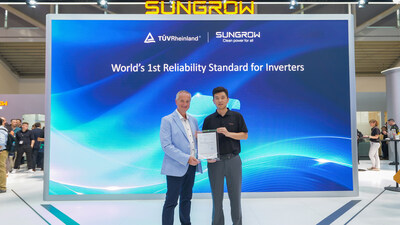
Sungrow's SG510HX string inverter and its IGBT modules were among the first products certified under the two standards, providing early validation of the framework in practical applications.
Meeting the Demands of Modern PV Plants
As PV power plants continue to expand into increasingly demanding environments such as deserts, offshore locations, and high-altitude regions, ensuring inverter reliability over 25 years of operation has become increasingly important for project owners and investors. However, existing reliability qualification methodologies were not originally designed to fully capture the increasingly diverse and demanding operating conditions of modern PV plants, creating a gap between laboratory qualification and long-term field performance.
To address this challenge, Sungrow and TÜV Rheinland have developed a comprehensive reliability evaluation framework that enables a more scientific, quantitative, and traceable assessment of inverter lifetime performance.
From Systems to Components: A Unified Reliability Validation Framework
Facing the shortcomings of traditional standards, the dual framework establishes a robust, quantifiable reliability methodology spanning the entire "system-component" validation continuum.
Together, the standards establish a system-to-component validation chain: 2 PfG 3325 provides a quantitative data basis for inverter -level reliability modeling and supplier evaluation, while 2 PfG 3328 - Part 2 defines a unified inverter -level validation framework with testable and traceable criteria.
New Standards Upgraded for Complex Scenarios
Addressing the issue of insufficient coverage in traditional standard scenarios, the standards added several enhanced test items designed for complex operating conditions.
The standards significantly strengthen reliability verification by expanding test coverage for complex operating scenarios.
Quantifiable Lifetime Assessment
To improve the quantitative assessment of long-term field reliability, the standards establish data-driven lifetime models based on extensive field performance data from PV power plants. The standards also draw on automotive components' reliability testing and quality verification standards such as VW 80000 and GMW 3172, adopting more stringent test approaches to evaluate long-term stability under complex operating conditions.
"The two standards establish a structured and verifiable framework for long-term inverter reliability evaluation, offering valuable references for manufacturers, investors, and insurers in assessing lifecycle performance," said Thomas Haupt, Vice President of Solar & Commercial Products, European Region of TÜV Rheinland Group.
Why Sungrow
As the pioneering architect of these standards, Sungrow leveraged its 29 years of expertise in power electronics together with extensive global project experience and operational insights across diverse climates and applications. Steering the reliability evaluation of PV inverters away from subjective empirical deductions toward a scientifically quantifiable, verifiable, and traceable future.
Photo - https://mma.prnewswire.com/media/3005616/111.jpg
Logo - https://mma.prnewswire.com/media/1344575/Logo.jpg
 View original content:https://www.prnewswire.co.uk/news-releases/sungrow-and-tuv-rheinland-redefine-industry-rule-worlds-first-inverter-long-term-reliability-corporate-standards-released-302823493.html

Die Mayr-Melnhof Gruppe (MM Gruppe) zählt erstmals zu den „Europe’s Climate Leaders 2026“, einem Ranking der Financial Times, das europäische Unternehmen mit nachweislichen Fortschritten beim Klimaschutz auszeichnet. Die Aufnahme in die Liste gilt für den Konzern als zusätzliche externe Bestätigung seiner langfristig ausgerichteten Nachhaltigkeitsstrategie und der bisherigen Reduktion von Treibhausgasemissionen.
Das Ranking wurde von Statista in Zusammenarbeit mit der Financial Times erstellt und umfasst insgesamt 600 Unternehmen aus Europa. Bewertet wurden vor allem die Verringerung der direkten und indirekten kernnahen Emissionen (Scope 1 und Scope 2) sowie die Entwicklung der Emissionsintensität im Zeitraum von 2019 bis 2024. Ergänzend flossen klimabezogene Kennzahlen wie Bewertungen durch die Non-Profit-Organisation CDP und die Zielsetzungen im Rahmen der Science Based Targets initiative (SBTi) in die Analyse ein.
Für die MM Gruppe zahlt sich insbesondere ihre ESG-Positionierung aus: Das Unternehmen verweist auf eine CDP-„Triple-A“-Bewertung in den Bereichen Klimawandel, Wälder und Wassersicherheit. Zudem sind die Klimaziele des Karton- und Verpackungsspezialisten von der SBTi validiert und an einem Dekarbonisierungspfad ausgerichtet, der sich am 1,5-Grad-Ziel orientiert. Diese Faktoren waren mitentscheidend für die Einstufung als eines der führenden europäischen Unternehmen beim Klimaschutz.
Vorstandsvorsitzender Peter Oswald sieht in der Auszeichnung den Beleg für die konsequente Umsetzung der Nachhaltigkeitsagenda der vergangenen Jahre. Die Kombination aus ambitionierten, wissenschaftsbasierten Zielen und der Übersetzung dieser Ziele in messbare Emissionsreduktionen stärke aus seiner Sicht nicht nur die ökologische Bilanz, sondern auch die unternehmerische Positionierung der MM Gruppe im europäischen Markt.