SEOUL, South Korea, Sept. 17, 2026 /PRNewswire/ -- The Supreme Court of Singapore and the Supreme Court of Korea signed two new instruments aimed at supporting the effective resolution of cross-border civil and commercial disputes on 16 September 2026.
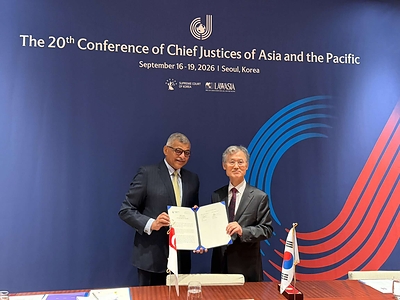
The Memorandum of Guidance as to the Enforcement of Money Judgments (MOG) and the Memorandum of Understanding on Cooperation Regarding Information on Foreign Law (MOU) were signed by The Honourable the Chief Justice Sundaresh Menon and Chief Justice Jo Hee-de of the Supreme Court of Korea. The signing took place in Seoul on the sidelines of the 20th Conference of Chief Justices of Asia and the Pacific, following a courtesy call between the two Chief Justices.
The MOG sets out the Singapore and Korean courts' understanding of the procedures and requirements for the recognition and enforcement of money judgments of one jurisdiction in the other. It covers judgments requiring payment of a sum of money and does not cover non-monetary relief or criminal orders, fines or penalties.
The MOG will serve as a practical reference for litigants and practitioners in cross-border cases by setting out the applicable legal requirements and procedures in both jurisdictions. This will provide greater clarity and understanding for parties seeking to a Singapore money judgment recognised and enforced in Korea, or a Korean money judgment recognised and enforced in Singapore.
Chief Justice Menon said: "A judgment may offer little real relief if it cannot be enforced where the judgment debtor or its assets are located. By explaining how our respective courts approach the recognition and enforcement of money judgments, the Memorandum will promote greater clarity, certainty and confidence for litigants."
The MOU establishes a mechanism for the Singapore and Korean courts to exchange information on their respective domestic laws and judicial practices in civil and commercial matters. It applies where a court is required to consider the law of the other jurisdiction in an ongoing international civil or commercial case.
Through the MOU, the Singapore and Korea courts will have a clearer and more efficient channel for obtaining reliable information on each other's laws and judicial practices in cross-border civil and commercial cases. Information exchanged may include relevant legislation, judicial precedents, decisions, interpretations and court orders. This will support the courts in determining questions of foreign law more accurately and efficiently.
For more details, visit News and speeches (judiciary.gov.sg)
 View original content to download multimedia:https://www.prnewswire.co.uk/news-releases/supreme-courts-of-singapore-and-korea-sign-new-arrangements-to-support-cross-border-civil-and-commercial-disputes-302881863.html

Der bewaffnete Juwelenraub im Wiener Museum für angewandte Kunst (MAK) vom 27. August ist nach Einschätzung externer Fachleute nicht auf Versäumnisse der Institution zurückzuführen. Ein 34 Seiten umfassendes Gutachten des Sicherheitsconsulting-Unternehmens LifeLine's kommt zu dem Schluss, dass das Haus sowohl bei den technischen Sicherheitsvorkehrungen als auch beim operativen Vorgehen während des Überfalls und im anschließenden Krisenmanagement korrekt gehandelt hat. Die zentrale Frage, ob das Ereignis sicherheitstechnisch und organisatorisch adäquat bewältigt wurde, beantworten die Gutachter mit einem „klaren Ja“.
Im Fokus der Untersuchung stand die Ausstellung „Glanzstücke. Van Cleef & Arpels High Jewelry x Masterpieces from the MAK Collection“, in deren Juwelenraum zwei bewaffnete Täter mitten am Nachmittag eine Vitrine einschlugen und mit einem historischen Diamantcollier flüchteten. Laut Bericht waren alle mit den Vertragspartnern vereinbarten Sicherheitsstandards und Normen erfüllt. Dazu zählten unter anderem der Einsatz von 185 Videokameras, einer dreistelligen Zahl von Alarmsensoren, speziellem Sicherheitsglas sowie geschultem Sicherheitspersonal. Der nach der Tat eingeführte Einsatz von Metalldetektoren war laut Gutachten zuvor weder verlangt noch durch bestehende Standards vorgesehen.
Besonders hervor hebt der Bericht die bewusste Entscheidung für den Vorrang des Personenschutzes vor dem Objektschutz. Aus diesem Grund verzichtete das Museum auf laute Alarmsignale während der Öffnungszeiten und auf bewaffnete Sicherheitskräfte im Ausstellungsbereich. Die direkte Alarmierung von Polizei und hauseigener Sicherheitszentrale wurde den Angaben zufolge um 14:01:22 Uhr ausgelöst und habe „optimal und effizient“ funktioniert. Auch das Verhalten der anwesenden Securitas-Mitarbeitenden wird positiv bewertet: Sie hätten eine unmittelbare Konfrontation mit den bewaffneten Tätern und damit das Risiko einer Eskalation, etwa durch Panik oder mögliche Geiselnahmen, vermieden.
Die Gutachter kommen insgesamt zu dem Befund, dass ein von professionellen Tätern geplanter und durchgeführter Raub unter regulären Öffnungsbedingungen mit „vernünftigen Mitteln“ nicht vollständig zu verhindern gewesen sei – selbst bei Einsatz moderner Überwachungstechnik und etablierter Sicherheitsprotokolle. Aus ihrer Sicht bestätigt der Fall eine bekannte Grenze musealer Schutzkonzepte: Absolute Sicherheit wäre nur um den Preis massiver Einschränkungen der Bewegungsfreiheit von Besucherinnen und Besuchern zu erreichen, formuliert das Gutachten sinngemäß. Das MAK wird damit für den konkreten Vorfall entlastet, auch wenn der spektakuläre Coup die Debatte über Sicherheitsstandards in Ausstellungshäusern neu anheizen dürfte.