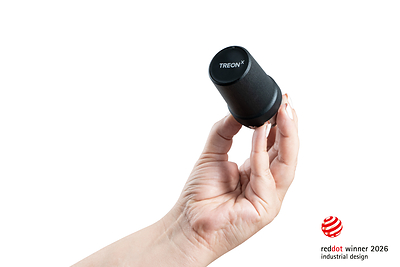
TAMPERE, Finland, July 7, 2026 /PRNewswire/ -- Treon, a leader in AI-native Smart Industry solutions, today announced that its Industrial Node X vibration sensor has received the Red Dot Award 2026: Product Design, one of the world's most prestigious international recognitions for design excellence.
Designed for the AI-Driven Industrial Future
Global industry is at a turning point as artificial intelligence (AI) becomes an increasingly integral part of industrial operations. However, successful AI transformation requires machines to sense, understand, and respond as part of AI-driven processes. Achieving this in harsh industrial environments – where high temperatures, dust, electromagnetic interference, and potentially explosive atmospheres are common – demands a new generation of industrial sensing technology.
The award-winning Treon Industrial Node X was developed to enable physical AI on industrial assets operating in these demanding conditions, enabling reliable data collection and AI-driven decision-making where it matters most.
Enabling Reliable Industrial Digitalization
The Treon Industrial Node X combines sophisticated engineering with a rugged industrial design. Every aspect of the device has been carefully designed to support the digitalization of critical industrial machinery in the most demanding environments.
As a key component of Treon Make, Treon's AI-driven prescriptive maintenance solution, Industrial Node X continuously collects high-resolution asset data, processes it at the edge, and transmits it wirelessly to the AI analytics engine running on the Treon Connect cloud platform. This enables automated fault detection and characterization months before a failure is expected to occur, helping prevent costly production interruptions and unplanned downtime.
Award-Winning Features
Treon Industrial Node X is optimized to monitor a wide range of critical industrial equipment, including motors, pumps, fans, compressors, and slow-rotating machinery such as gearboxes. The sensor measures three-axis vibration velocity and acceleration, electromagnetic fields, temperature, and rotation speed with market-leading accuracy. These high-quality measurements provide a reliable foundation for AI-driven analytics and decision-making. Smart edge-computing allows the device to transmit both raw and pre-processed data, reducing network traffic while extending battery life.
Industrial Node X includes a unique replaceable battery with electromagnetic shielding and a service life of up to five years. This design lowers customers' costs while supporting sustainability goals by reducing waste and extending device lifespan. The device is also certified for use in hazardous environments through international Ex certifications, making it suitable for industries such as oil and gas, chemicals, and petrochemicals.
The self-healing wireless mesh networking technology further enhances reliability and scalability, providing robust connectivity across large industrial sites while ensuring continuous data collection. Several innovative solutions incorporated into the Industrial Node X design are protected by pending patents.
Learn more about the Treon Industrial Node X vibration sensor.
About Treon
Treon is a global leader in AI-driven Smart Industry solutions, helping businesses improve productivity, increase operational visibility, and advance long-term sustainability. Its fully integrated predictive maintenance solutions combine advanced AI analytics, a mobile-first user experience, automated workflows, and wireless vibration monitoring delivered as a managed service with scalable subscription pricing. Treon serves more than 200 customers worldwide across manufacturing, material handling, and logistics industries. Learn more at www.treon.fi.

 View original content to download multimedia:https://www.prnewswire.co.uk/news-releases/treon-industrial-node-x-vibration-sensor-wins-prestigious-red-dot-product-design-award-302819064.html

Die Artenvielfalt von Taufliegen (Drosophila) im Raum Wien ist in den vergangenen drei Jahrzehnten massiv eingebrochen. Forschende des Naturhistorischen Museums (NHM) Wien berichten, dass die Zahl der in der Stadt nachgewiesenen Arten im Vergleich zu einer Erhebung aus dem Jahr 1994 um rund 50 Prozent gesunken ist. Die Ergebnisse, die nun im Fachjournal „Ecology and Evolution“ veröffentlicht wurden, deuten darauf hin, dass vormals häufige Arten durch zugewanderte Taufliegen verdrängt worden sein könnten.
Grundlage der aktuellen Analyse ist das Citizen-Science-Projekt „Vienna City Fly“, das 2024 einfache Fliegenfallen an freiwillige Laienforscher in Wien, Niederösterreich und dem Burgenland verteilte. Die zurückgesandten Proben wurden für die nun publizierte Studie gezielt auf Fänge in unmittelbarer Nähe menschlicher Siedlungen beschränkt – also auf Innenräume, Balkone und Gärten. Damit liegt ein detailliertes Bild jener Drosophila-Gemeinschaft vor, die besonders eng an vom Menschen geprägte Lebensräume gebunden ist.
Insgesamt wurden mehr als 18.000 Taufliegen gesammelt und taxonomisch bestimmt; dabei identifizierte das Team um NHM-Forscher Martin Kapun 13 Drosophila-Arten. Bemerkenswert ist der Nachweis zweier Arten, die bislang in Österreich nicht registriert waren: Drosophila (D.) mercatorum und D. virilis. D. mercatorum ist ursprünglich in den USA, Mexiko und Südamerika verbreitet und wurde im vergangenen Jahrhundert nach Europa eingeschleppt, D. virilis stammt aus Asien und hat sich erst seit relativ kurzer Zeit über die nördliche Hemisphäre ausgebreitet.
Die Zusammensetzung der Populationen zeigt eine deutliche Verschiebung hin zu wenigen dominanten Generalisten. D. mercatorum mit rund 8.800 Nachweisen und die Modellorganismus-Art D. melanogaster mit etwa 6.700 Funden waren die mit Abstand häufigsten Spezies in den Proben. „Dominiert wird die Drosophila-Population im Wiener Stadtgebiet von Generalisten mit starker Affinität zum Menschen“, erklärte Kapun der Austria Presse Agentur zufolge. Die Ergebnisse unterstreichen, dass zunehmende Verbauung und die starke Prägung durch menschliche Siedlungen mit einem Rückgang der Biodiversität einhergehen können – auch bei unscheinbaren Insekten, die als wichtige Indikatoren für den Zustand urbaner Ökosysteme gelten.