HONG KONG, June 12, 2026 /PRNewswire/ -- As global air cargo hubs confront rising e-commerce demand, labour shortages, and decarbonisation targets, Westwell—a global AI company advancing smart and green container logistics—is applying its "AI + New Energy (Ainergy)" strategy to airport operations. Serving over 200 customers across 30+ economies, Westwell now brings its AI-Native capabilities to air cargo, seaport, rail, land transport, and smart factories.
At the core is a dual-AI architecture: Physical AI enables frontline autonomous execution, while Operational AI drives intelligent decision-making.
Designed for demanding airside conditions, Westwell's Q-Tractor is powered by the self-developed Q-Pilot autonomous driving platform, integrating BEV perception and Transformer-based end-to-end models. Redundant safety architectures ensure 24/7 reliability in all weather and visibility conditions. Centimetre-level automatic trailer coupling and uncoupling—validated across multiple airport deployments—closes the last gap in unmanned logistics, enabling autonomous cargo loading and unloading. Powered by pure electric drive, the Q-Tractor achieves zero emissions in core operations.
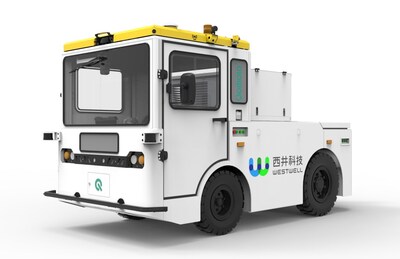
On the Operational AI layer, the ReeWell intelligent operations management platform, together with the WellFMS fleet management system, provides real-time dispatching, route optimisation, and coordinated decision-making across flights, cargo, vehicles, and energy resources—maximising fleet efficiency and capacity utilisation.
Westwell's solutions are being deployed at key air cargo hubs including Hong Kong International Airport, Hong Kong Air Cargo Terminals Limited (Hactl), Shanghai Pudong International Airport, Ezhou Huahu International Airport, and newly secured projects at Fuzhou Changle International Airport and Xiamen Xiang'an International Airport.
In 2025, Westwell officially received approval to deploy new energy autonomous tractors at Hactl - the largest independent air cargo handler in Hong Kong. Westwell's Q-Tractors power unmanned cargo transportation operations at the terminal, enhancing productivity while accelerating Hactl's smart and green transformation.
At Shanghai Pudong International Airport, Westwell is expanding AI applications into airport safety operations beyond cargo transportation - the company is developing an industry-leading "AI + Autonomous Driving + FOD Detection" intelligent runway inspection solution, combining autonomous vehicles, radar systems and AI recognition algorithms to support the safe operation of flights.
As airports continue balancing efficiency, resilience and sustainability targets, AI-Native operational systems are expected to play an increasingly strategic role in air cargo infrastructure development. For Westwell, the future of airport logistics lies not simply in automation, but in building collaborative ecosystems where people, intelligent vehicles and AI systems work together more safely, efficiently and sustainably.
Photo - https://mma.prnewswire.com/media/2996737/image2.jpg
 View original content:https://www.prnewswire.co.uk/news-releases/westwell-rebuilding-air-cargo-operations-through-ai-native-logistics-302798822.html

Bei der Verleihung des BRICK AWARD 26 in Wien hat ein vietnamesisches Projekt den Ton für die internationale Ziegelarchitektur vorgegeben: Der Đạo Mẫu-Tempel mit angeschlossenem Museum wurde mit dem Grand Prize ausgezeichnet. Das Gebäude, das laut Veranstalter CO2-negativ errichtet wurde, setzt auf lokale Tonziegel und gilt als besonders ressourcenschonend. Die Gala in der österreichischen Hauptstadt zeigte, wie weit das Spektrum zeitgenössischer Keramikarchitektur inzwischen reicht – von religiösen Stätten in Asien bis zu Industrieanlagen in Lateinamerika.
Der BRICK AWARD wird seit 2004 alle zwei Jahre vergeben und versteht sich als herstellerunabhängige Plattform für Architekturbüros, die mit Ziegeln und Keramik arbeiten. Ausrichter ist der Baustoffkonzern Wienerberger, der mit dem Preis ein internationales Netzwerk von Pionieren der Ziegelarchitektur bündelt. Prämiert wird in fünf Kategorien: „Feeling at home“ für Einfamilienhäuser und kleinere Projekte, „Living together“ für städtische Wohnanlagen, „Working together“ für Gewerbe- und Industriebauten, „Sharing public spaces“ für öffentliche Gebäude und Räume sowie „Building outside the box“ für besonders innovative Ansätze.
Auf der Ebene der Einzelkategorien spiegelten die diesjährigen Gewinner zentrale Branchentrends wider. In der Kategorie „Feeling at home“ wurde ein offenes Einfamilienhaus auf Mallorca ausgezeichnet, das mithilfe speziell gesetzter Wände den Meerblick maximiert und zugleich Privatsphäre schafft. „Living together“ entschied ein gemischt genutztes Gebäude in Barcelona für sich, das nachhaltige Ziegel mit einem sozialen Innenhof kombiniert und damit auf dichte, aber gemeinschaftlich orientierte Stadtentwicklung setzt. In „Working together“ ging die Auszeichnung an ein Lager- und Bürogebäude in Mexiko, das lokale Keramik und vulkanisches Material integriert und so industrielle Nutzung und regionale Baustoffe verbindet.
Erstmals vergab die Jury zusätzlich einen Sonderpreis für innovatives gemeinschaftliches Wohnen. Dieser ging an ein Projekt in Belgien, das wiederverwendete Ziegel einsetzt, um eine nachhaltige Nachbarschaft zu schaffen. Der Fokus auf Recycling, CO2-Reduktion und lokale Materialien zieht sich damit durch zentrale Gewinnerprojekte des BRICK AWARD 26. Für Wienerberger, dessen Aktie zum Zeitpunkt der Meldung bei 22,71 Euro notierte, schärft die Auszeichnung zugleich das Profil als global vernetzter Akteur im Bereich Ziegel- und Keramiklösungen – mit dem nächsten Termin im Finanzkalender, der Quartalsmitteilung am 12. August 2026, bereits in Sichtweite.