SEOUL, South Korea, Oct. 6, 2026 /PRNewswire/ -- HD Hyundai has delivered the world's first "Lashing-Free" container ship, introducing a new concept that eliminates the need for workers to manually secure containers on board.
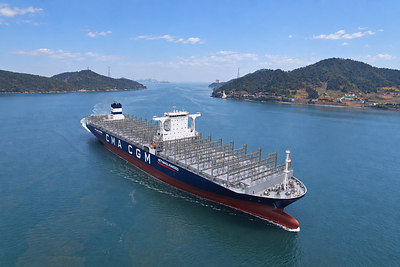
HD Hyundai announced on Tuesday, October 6, that it recently delivered a 13,000-TEU container ship for a French shipping company, with its hybrid-type Lashing-Free technology partially applied.
HD Hyundai Heavy Industries independently developed and validated all key components of the Lashing-Free technology, while HD Hyundai Samho was responsible for the detailed design and construction of the vessel incorporating the system.
The Lashing-Free container ship removes the need for manual container lashing, which has traditionally been carried out by workers using lashing equipment on large container vessels. It also incorporates technologies designed to prevent cargo loss and maximize logistics efficiency.
The vessel extends the cell guides, which support containers stacked vertically in alignment inside the cargo hold, all the way above deck.
With conventional large hatch covers, however, the extended cell guides would be obstructed, preventing them from reaching above deck. To overcome this structural limitation, HD Hyundai Heavy Industries developed a standardized portable bench that can be installed between the cell guides.
The portable bench is built to the same dimensions as a 40-foot container, allowing it to be handled using the same port cranes used to load and unload containers. The technology is expected to play a key role in accelerating automation and unmanned operations across the broader logistics network connecting land and sea, including container terminals.
HD Hyundai Heavy Industries has also developed a Twistlock Rooting System, which securely fastens containers stowed outside the cell guide area to the vessel's structure.
As a result, the Lashing-Free container ship can carry over 10% additional cargo weight on deck compared with conventional vessels of the same type. The system also provides stable support for containers even in rough seas and strong winds, helping prevent cargo loss, enhance maritime safety and reduce the risk of marine pollution.
Sea trials conducted by HD Hyundai in September showed that the Lashing-Free system significantly reduces vibration during operation compared with conventional designs using hatch covers and lashing bridges. The company is also developing a next-generation version of the technology incorporating weathertight features.
"We plan to expand the application of this new container transportation technology to small- and medium-sized vessels," said Hongryeul Ryu, Senior Executive Vice President and Chief Technology Officer at HD Hyundai Heavy Industries. "By continuing to develop differentiated technologies that deliver tangible value to customers in areas such as safety, loading efficiency and automation, we aim to further strengthen our ability to secure new orders."
Meanwhile, HD Hyundai Heavy Industries' Lashing-Free technology was introduced as a representative Korean technology related to "measures to prevent the loss of containers at sea" at the 10th session of the International Maritime Organization's Sub-Committee on Carriage of Cargoes and Containers (CCC) in 2024. The technology has secured multiple intellectual property registrations in Korea and overseas and was also selected as a recipient of this year's IR52 Jang Young-shil Award.

 View original content to download multimedia:https://www.prnewswire.co.uk/news-releases/hd-hyundai-delivers-worlds-first-lashing-free-container-ship-302899537.html

Der bewaffnete Juwelenraub im Wiener Museum für angewandte Kunst (MAK) vom 27. August ist nach Einschätzung externer Fachleute nicht auf Versäumnisse der Institution zurückzuführen. Ein 34 Seiten umfassendes Gutachten des Sicherheitsconsulting-Unternehmens LifeLine's kommt zu dem Schluss, dass das Haus sowohl bei den technischen Sicherheitsvorkehrungen als auch beim operativen Vorgehen während des Überfalls und im anschließenden Krisenmanagement korrekt gehandelt hat. Die zentrale Frage, ob das Ereignis sicherheitstechnisch und organisatorisch adäquat bewältigt wurde, beantworten die Gutachter mit einem „klaren Ja“.
Im Fokus der Untersuchung stand die Ausstellung „Glanzstücke. Van Cleef & Arpels High Jewelry x Masterpieces from the MAK Collection“, in deren Juwelenraum zwei bewaffnete Täter mitten am Nachmittag eine Vitrine einschlugen und mit einem historischen Diamantcollier flüchteten. Laut Bericht waren alle mit den Vertragspartnern vereinbarten Sicherheitsstandards und Normen erfüllt. Dazu zählten unter anderem der Einsatz von 185 Videokameras, einer dreistelligen Zahl von Alarmsensoren, speziellem Sicherheitsglas sowie geschultem Sicherheitspersonal. Der nach der Tat eingeführte Einsatz von Metalldetektoren war laut Gutachten zuvor weder verlangt noch durch bestehende Standards vorgesehen.
Besonders hervor hebt der Bericht die bewusste Entscheidung für den Vorrang des Personenschutzes vor dem Objektschutz. Aus diesem Grund verzichtete das Museum auf laute Alarmsignale während der Öffnungszeiten und auf bewaffnete Sicherheitskräfte im Ausstellungsbereich. Die direkte Alarmierung von Polizei und hauseigener Sicherheitszentrale wurde den Angaben zufolge um 14:01:22 Uhr ausgelöst und habe „optimal und effizient“ funktioniert. Auch das Verhalten der anwesenden Securitas-Mitarbeitenden wird positiv bewertet: Sie hätten eine unmittelbare Konfrontation mit den bewaffneten Tätern und damit das Risiko einer Eskalation, etwa durch Panik oder mögliche Geiselnahmen, vermieden.
Die Gutachter kommen insgesamt zu dem Befund, dass ein von professionellen Tätern geplanter und durchgeführter Raub unter regulären Öffnungsbedingungen mit „vernünftigen Mitteln“ nicht vollständig zu verhindern gewesen sei – selbst bei Einsatz moderner Überwachungstechnik und etablierter Sicherheitsprotokolle. Aus ihrer Sicht bestätigt der Fall eine bekannte Grenze musealer Schutzkonzepte: Absolute Sicherheit wäre nur um den Preis massiver Einschränkungen der Bewegungsfreiheit von Besucherinnen und Besuchern zu erreichen, formuliert das Gutachten sinngemäß. Das MAK wird damit für den konkreten Vorfall entlastet, auch wenn der spektakuläre Coup die Debatte über Sicherheitsstandards in Ausstellungshäusern neu anheizen dürfte.