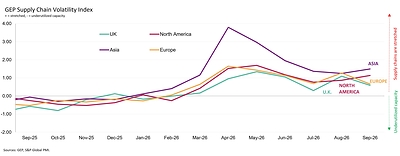
CLARK, N.J., Oct. 12, 2026 /PRNewswire/ -- GEP Global Supply Chain Volatility Index — a leading indicator tracking demand conditions, shortages, transportation costs, inventories and backlogs, based on a monthly survey of 27,000 businesses — showed global manufacturers ramping up purchases of raw materials and components in September as underlying demand strengthened.
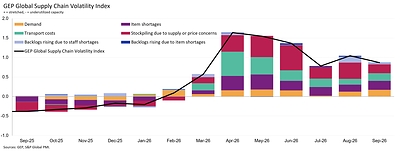
Global input demand growth rose to its strongest since May and was close to its 2026 high, signaling firmer manufacturing activity heading into the fourth quarter. Purchasing strengthened across North America, Asia and Europe, with particularly strong increases in the United States, Germany, Taiwan and South Korea.
At the same time, supply pressures intensified. Shortages increased for the first time since May, while global transportation costs also rose. Shortages of oil and oil-based products were particularly acute, creating renewed cost and availability pressures for manufacturers.
"Manufacturers are buying more because demand is strengthening, but they're doing so at a time when shortages and transportation costs are starting to rise again," said John Piatek, vice president, GEP Consulting. "For companies, that means the priority shifts from simply protecting inventory to securing supply and controlling costs. If demand continues to build through the fourth quarter, businesses that wait will face tighter availability and higher input costs."
Interpreting the data:
Index > 0, supply chain capacity is being stretched. The further above 0, the more stretched supply chains are.
Index < 0, supply chain capacity is being underutilized. The further below 0, the more underutilized supply chains are.
SEPTEMBER 2026 REGIONAL KEY FINDINGS
SEPTEMBER 2026 KEY FINDINGS
For more information, visit www.gep.com/volatility.
Note: Full historical data dating back to January 2005 is available for subscription. Please contact economics@spglobal.com.
The next release of the GEP Global Supply Chain Volatility Index will be 8 a.m. ET, Nov. 11, 2026.
About the GEP Global Supply Chain Volatility Index
The GEP Global Supply Chain Volatility Index is produced by S&P Global and GEP. It is derived from S&P Global's PMI® surveys, sent to companies in over 40 countries, totaling around 27,000 companies. The headline figure is a weighted sum of six sub-indices derived from PMI data, PMI Comments Trackers and PMI Commodity Price & Supply Indicators compiled by S&P Global.
A Supply Chain Volatility Index is also published at a regional level for Europe, Asia, North America and the U.K. For more information about the methodology, click here.
Media Contacts
Derek Creevey
Director, Public Relations
GEP
Phone: +1 646-276-4579
Email: derek.creevey@gep.com
Joe Hayes
Senior Principal Economist
S&P Global Market Intelligence
Phone: +44-1344-328-099
Email: joe.hayes@spglobal.com
 View original content to download multimedia:https://www.prnewswire.co.uk/news-releases/manufacturers-ramp-up-purchasing-in-september-as-global-demand-strengthens-gep-global-supply-chain-volatility-index-302905220.html

Bei den Vereinigten Bühnen Wien (VBW) steht ein markanter Wechsel an der Spitze an: Mit 1. Dezember übernimmt die deutsch-österreichische Kulturmanagerin Andrea Pier die Geschäftsführung des städtischen Theaterkonzerns von Franz Patay. Der 65-Jährige hatte die VBW seit 2016 geleitet und war insgesamt zehn Jahre in geschäftsführender Verantwortung. Unter seinem Kommando mussten die Häuser – Raimund Theater, Ronacher und das Musiktheater an der Wien – heuer Einsparungen von fünf Millionen Euro verkraften, womit das Jahresbudget auf 51 Millionen Euro sank. Der Führungswechsel erfolgt damit in einer Phase, die von Budgetdruck und Konsolidierungszwängen geprägt ist.
Mit Pier steht erstmals offiziell eine Frau dauerhaft an der Spitze der Vereinigten Bühnen Wien; ein nur kurzes Interregnum von Lia Metchev-Herbst im Jahr 2016 ausgenommen. Die 1969 in Bielefeld geborene Managerin setzte sich in einem von der externen Personalberatung Christoph la Garde organisierten Auswahlverfahren gegen 18 Mitbewerberinnen und Mitbewerber durch. Die Hearing-Kommission – unter anderem mit der VBW-Aufsichtsratsvorsitzenden Elisabeth Freismuth, der Direktorin des Jüdischen Museums Wien, Barbara Staudinger, sowie Wien-Holding-Geschäftsführerin Karin Ramser – entschied sich einstimmig für Pier und hob insbesondere ihre Doppelkompetenz im öffentlichen Kultursektor und in der Privatwirtschaft hervor.
Pier war in den vergangenen fünf Jahren als Managing Director maßgeblich für das Projekt Kulturhauptstadt Chemnitz 2025 verantwortlich und zuvor zwei Jahrzehnte in unterschiedlichen leitenden Funktionen beim Musical- und Theaterkonzern Stage Entertainment tätig. Dort leitete sie unter anderem das traditionsreiche Theater des Westens in Berlin und verantwortete das Tourgeschäft. Mit Blick auf die Sparvorgaben in Wien verweist sie auf ihre Erfahrung im privatwirtschaftlichen Umfeld: Entscheidend sei, „die richtigen Weichen zu stellen, um weiterhin die künstlerische Exzellenz hochzuhalten“. An der internen Budgetverteilung zwischen Oper und Musical sieht sie derzeit keinen Änderungsbedarf und kündigt an, vorerst auf Kontinuität zu setzen.
Trotz zusätzlicher Konkurrenz durch das im Bau befindliche private „Theater im Prater“ zeigt sich Pier gelassen. Wichtiger als strukturelle Eingriffe sei für sie ein klarer künstlerischer Kurs, den sie mit „großem Tatendrang“ ab Dezember in Wien verfolgen will. Für die Stadt markiert ihre Bestellung auch eine personelle Weichenstellung: Vizebürgermeisterin Barbara Novak und Kulturstadträtin Veronica Kaup-Hasler, die Pier im Ronacher gemeinsam mit Wien-Holding-Chefin Ramser präsentierten, betonten die Bedeutung ihrer langjährigen Musical- und Managementerfahrung für die künftige Positionierung der Vereinigten Bühnen Wien im internationalen Wettbewerb.